Owner complaints
58NHTSA recordsUSED VEHICLE RESEARCH
2018 Toyota 4Runner
Research the 2018 Toyota 4Runner using available NHTSA owner complaints, safety recalls, manufacturer communications, defect investigations, and CarIQ data-coverage analysis.
DATA CONFIDENCE: Moderate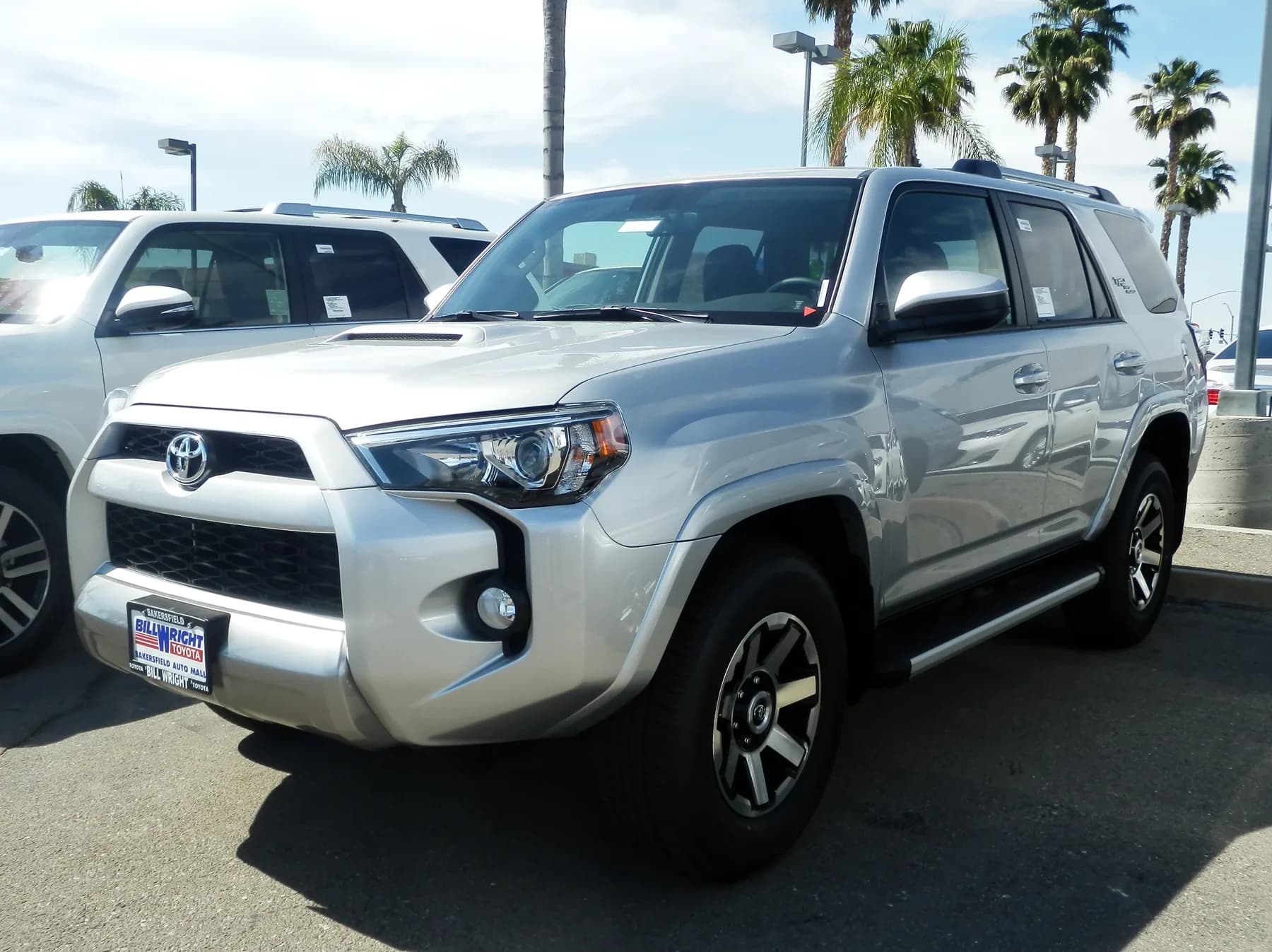 Representative image
Recall campaigns
5Year, make and model lookupManufacturer communications
192Matched NHTSA recordsInvestigations
0Matched NHTSA recordsSUBJECTIVE OWNER FEEDBACK
OWNER EXPERIENCE
What it is like to live with the vehicle—kept clearly separate from official NHTSA evidence.
THE FIRST USEFUL PERSPECTIVE COULD BE YOURS
No approved owner experiences yet.
Contributions are collected carefully and only appear here after moderation. No placeholders, sample testimonials, or invented sentiment.OWNED THIS CAR?
Help the next buyer understand the real ownership experience.
Share what you liked, what could be better, and whether you would choose it again. Every contribution is moderated before publication.INDEPENDENT EVIDENCE TYPES
NHTSA owner complaint records remain part of Official Vehicle Data. Subjective review contributions remain in Owner Experience. One does not validate or prove the other. Read the methodology.
EVIDENCE, NOT A SCORE
WHAT THIS DATA CAN TELL YOU ABOUT RELIABILITY
Official records can provide useful research context, but each source has a different meaning. Complaint counts are not failure rates; recalls are formal safety campaigns; manufacturer communications are technical or service documentation; and investigations reflect formal NHTSA activity. Data Confidence measures evidence availability, not vehicle quality. CarIQ does not publish a composite Reliability Score.
Available evidence summary: 58 NHTSA owner complaint records; 5 safety recall campaigns; 192 manufacturer communications; 0 applicable NHTSA defect investigations.
EVIDENCE AVAILABILITY — NOT VEHICLE RELIABILITY
DATA CONFIDENCE
ModerateData Confidence measures how much usable evidence CarIQ has for this vehicle. It does not measure how reliable the vehicle is.
Why this rating?
- Owner complaint data
- Available
- Manufacturer communications
- Available
- Recall data
- Available
- Investigation data
- Available
- Production denominator
- Unavailable
- Complaint component completeness
- 100%
- Mileage completeness
- 0%
- Incident-date completeness
- 100%
DESCRIPTIVE ANALYTICS
DATA INSIGHTS
Derived from official NHTSA source records. These statistics are descriptive and are not a reliability score.
- Complaint records analyzed
- 58 NHTSA complaints
- Most reported component
- Steering 19% of categorized complaint records
- Top-three component concentration
- 47% Records mentioning at least one top-three component
- Median reported incident mileage
- Not available from current source 0 valid mileage observations
- Recall campaigns
- 5 NHTSA recalls
- Most recent recall report
- November 4, 2020 NHTSA recalls
- Manufacturer communications
- 192 NHTSA manufacturer communications
- Most documented component
- Equipment 29% of categorized communications
- Top-three communication concentration
- 55% Share of categorized manufacturer communications
SOURCE COMPLETENESS
DATA QUALITY
- Complaint records analyzed
- 58
- Component classification available
- 100%
- Incident date available
- 100%
- Mileage available
- 0%
- Structured outcome fields available
- 100%
Completeness describes fields present in the retrieved complaint records. It is not a data-quality grade or a vehicle assessment.
Learn about CarIQ methodologyPRODUCTION-ADJUSTED DESCRIPTIVE METRIC
NORMALIZED COMPLAINT CONTEXT
Production-normalized complaint data is not currently available for this vehicle.
This metric compares the number of NHTSA owner complaint records retrieved by CarIQ with NHTSA-reported production volume for the corresponding vehicle population.
It is not a vehicle failure rate. Complaint reporting behavior, vehicle age, time on the road, production definitions, and other factors can affect the result.
Source: National Highway Traffic Safety Administration, Early Warning Reporting, Light Vehicle Production Data. Read the methodology.
OFFICIAL NHTSA OWNER COMPLAINT DATA
PROBLEMS REPORTED IN NHTSA RECORDS
CarIQ groups available NHTSA owner complaint records for the 2018 Toyota 4Runner by vehicle system to make recurring documentation easier to research. Most represented complaint categories describe the retrieved records—not failure frequency.
TOTAL COMPLAINTS58
MOST REPRESENTED COMPLAINT CATEGORIES
Steering11 complaints
19%of categorized complaint records
Unknown or Other9 complaints
16%of categorized complaint records
Air Bags7 complaints
12%of categorized complaint records
Service Brakes6 complaints
10%of categorized complaint records
Engine5 complaints
9%of categorized complaint records
Fuel System5 complaints
9%of categorized complaint records
Gasoline5 complaints
9%of categorized complaint records
Structure5 complaints
9%of categorized complaint records
Electrical System4 complaints
7%of categorized complaint records
Fuel/propulsion System4 complaints
7%of categorized complaint records
Suspension4 complaints
7%of categorized complaint records
Power Train3 complaints
5%of categorized complaint records
Electronic Stability Control (ESC)2 complaints
3%of categorized complaint records
Seat Belts2 complaints
3%of categorized complaint records
Vehicle Speed Control2 complaints
3%of categorized complaint records
Visibility/wiper2 complaints
3%of categorized complaint records
Back Over Prevention1 complaint
2%of categorized complaint records
Exterior Lighting1 complaint
2%of categorized complaint records
Seats1 complaint
2%of categorized complaint records
Tires1 complaint
2%of categorized complaint records
Wheels1 complaint
2%of categorized complaint records
A complaint may list more than one component and therefore contribute to multiple categories. Percentages show the share of categorized complaint records that mention each component—not the percentage of vehicles affected. Category percentages may overlap.
INCIDENT REPORTS BY YEAR
2018
11
2019
11
2020
12
2021
7
2022
3
2023
2
2024
7
2025
3
2026
2
Grouped from complaint records with a valid incident date.
RECENT OWNER COMPLAINTS
Electrical System
Owner-submitted NHTSA complaint · ODI 11750896Read complaint narrative
Odometer Fraud. The contact purchased a 2018 Toyota 4Runner. The contact discovered that there was a mileage discrepancy per a Carfax report. The vehicle was a dealer sale. At the time of the purchase, the vehicle mileage was 65,862. However, the Carfax report indicated that the mileage was 61,000 in April 2022; 90,000 in February 2023; and 54,000 towards the end of the month in February 2023. The contact stated that the current approximate mileage was 86,000.
Air Bags · Service Brakes · Engine
Owner-submitted NHTSA complaint · ODI 11727554Read complaint narrative
The dealership Direct Motor, located in Manassas, Virginia, sold me this car in poor condition. On Sunday the 22nd, I picked up the car around 10 PM. They didn't show me any information about the car. When I picked it up, I saw that the front bumper and rear door were damaged, and the airbag lights were on, which is dangerous. I returned the car first thing Monday morning and asked them to exchange it. They refused. I asked for my money back, which is $3,000, and they refused again. Then I went back on Wednesday and filled out a form explaining why I returned the car. They said they would return my money, but now they're not responding. They're trying to scam me.
Steering · Suspension · Service Brakes
Owner-submitted NHTSA complaint · ODI 11710152Read complaint narrative
this vehicle was purchased from Don Chalmers Ford in Rio Rancho on 1129, 2025, upon purchasing a 2018 Toyota foreigner Limited I traded in a 2020 Acura RDX with only 50,000 miles. The salesman seemed to trustworthy. He showed me the Carfax Clean had no accidents no recalls then I receive some paperwork stating this vehicle is eligible for a buyback. I still have not received the license plate or registration. No one informed me that this vehicle is eligible for a buyback meaning I paid way too much for this vehicle. I’m having problems with suspension brakes steering wheel shaking at high speeds leaks lights on several problems. The dealership promised they would fix everything they have ignored me. I am frustrated. This is not a safe vehicle. I have PTSD from totaling my 1998 Toyota 4 runner October 11 of 2025. I was clear that I need a safe vehicle. My kids were in my vehicle when I totaled my 1998. I have been given the runaround since the second day my son saw oil leaking from the vehicle. Lights went on many different things began to happen like explain this is the second day the seventh day the 14th day and every day once a week after leaving several text messages phone calls I spoke to Zach the sales guy Steve the guy that purchased his parts he purchased a sensor in a black lining that goes be behind the tire on the passenger side. I have found overspray lights are on something to do with the tires, I am not safe in this vehicle I told them it was not a valid purchase and to please reimburse me give me my 2020 Acura that I only had 50,000 miles. Excellent condition. I didn’t know that I was gonna be manipulated lie to lack of information was disclosed to me. I didn’t know it was eligible for buyback. I overpaid for a vehicle that is not safe and should not be on their lot. I’m ready to go the general manager of the president. I have eight fractures in my spine with head injuries. My 18-year-old was in the car with me thank God we are our life today. I’m sad
Power Train · Vehicle Speed Control
Owner-submitted NHTSA complaint · ODI 11650452Crash reported
Read complaint narrative
While my father was exiting his 2018 Toyota 4Runner SR5, the vehicle unexpectedly started reversing fairly quickly, despite no foot being on the brake. He was dragged by the vehicle while attempting to stop it outside the car, and it continued moving backwards then down a hill before crashing into a fence, causing significant damage to both the car and the fence. This vehicle should not have rolled back at this speed, and it appears to be related to a potential design flaw in the vehicle’s brake-shift interlock system or automatic reverse functionality. This incident is concerning, and after reviewing discussions in various forums, it seems that similar issues may not be isolated to this particular vehicle and could point to a larger defect in Toyota vehicles. I am very disappointed that there are no built-in safety features that could have prevented this incident. It is extremely concerning that the vehicle shifted into reverse while the driver was in the process of exiting. A vehicle should not be able to reserve this quickly or move into reverse unintentionally without the driver’s control. This poses a serious safety risk to drivers and bystandards, and I strongly urge the NHTSA to investigate this issue and determine whether a defect or design flaw contributed to the incident. Implementing proper safeguards could prevent similar accidents in the future.
Fuel/propulsion System
Owner-submitted NHTSA complaint · ODI 11648461Read complaint narrative
Fuel pump make noises and I can hear it
Suspension
Owner-submitted NHTSA complaint · ODI 11611918Read complaint narrative
The front shock springs cracked and snapped due to cold weather. I have been waiting for 2 months for the replacement parts and cannot drive my vehicle. The parts are 4 months out on a waiting list. The vehicle is not safe to drive. The dealer has inpected the vehicle and said it is not safe to drive for safety reasons. There were no warning and I only found out when I went to replace the original tires. The car has 25K miles.
Service Brakes
Owner-submitted NHTSA complaint · ODI 11604973Read complaint narrative
While attempting to stop vehicle for a traffic light brake pedal suddenly goes almost to the floor. This occurrence is random and unpredictable. No dash lights or messages come on indicating any problem. Brake master cylinder is at the proper level and no signs of leakage. The vehicle has not yet been inspected by any technicians. Vehicle is available for inspection by NHTSA. As a retired Police officer and former FAA certified Airframe & Powerplant mechanic I am familiar with hydraulic systems. I believe that this issue if not identified and addressed by the manufacture will cause bodily harm to the operator and possibly other vehicles or pedestrians. There has also been a lot of chatter on Toyota forums about the same problem.
Engine
Owner-submitted NHTSA complaint · ODI 11603235Read complaint narrative
Two transfer case seals failed at 64,000 miles. Caused excessive oil to leak out of transfer case and onto the exhaust. Safety was put as risk by potential full failure of transfer case which can cause loss of power at speed or leaking oil on exhaust causing a fire. Problem was verified by Armstrong Automotive and repaired. No warning lights were present. Problem found after smelling burning oil and noticing smoking coming from underneath vehicle.
NHTSA complaints are reports submitted by vehicle owners and other consumers. Complaint counts do not represent the percentage of vehicles affected and do not by themselves establish that a safety defect exists.
A higher complaint count can partly reflect how many vehicles were sold, vehicle age, and other factors. CarIQ does not yet normalize complaint counts by vehicles sold.
Data provided by the National Highway Traffic Safety Administration (NHTSA). This site is not endorsed by NHTSA.
OFFICIAL NHTSA SAFETY RECALL DATA
SAFETY RECALLS
5 recall campaigns found
01FUEL SYSTEM, GASOLINE:DELIVERY:FUEL PUMPCampaign 20V682000November 4, 2020
Summary
Toyota Motor Engineering & Manufacturing (Toyota) is recalling certain 2018-2019 4Runner, 2019-2020 Avalon, 2019 Corolla Hatchback, 2017-2019 Highlander, 2018-2020 Camry, 2020 Corolla, 2018-2019 Land Cruiser, 2017-2020 Tacoma, 2019-2020 RAV4, 2019-2020 Sequoia, 2017-2020 Sienna, 2019-2020 Tundra, 2018-2020 Lexus ES350, 2017 Lexus GS200t, 2017-2019 Lexus GS350, 2019 Lexus GS300, 2018-2020 Lexus LC500h, 2019-2020 Lexus LS500, 2018-2019 Lexus GX460, 2017 Lexus IS200t, 2019 Lexus IS300, 2019 Lexus IS350, 2018-2020 Lexus LC500, 2018 Lexus LS500, 2019 Lexus LS500h, 2018-2019 Lexus LX570, 2017 Lexus RC200t, 2019 Lexus RC300, RC350, 2017 and 2019-2020 Lexus RX350, 2018-2020 RX350L, 2019 Lexus UX200, 2018-2019 Lexus NX300 vehicles. The low-pressure fuel pump inside the fuel tank may fail.
Safety Consequence
If the fuel pump fails, the engine can stall while driving, increasing the risk of a crash.
Remedy
Toyota will notify owners, and dealers will replace the fuel pump assembly with an improved one, free of charge. Owners of specific models were notified that remedy parts were available starting January 21, 2021. Owners of other models will be notified as remedy parts become available. Remedy parts should be available for all affected vehicles by late March 2021. Owners may contact Toyota customer service at 1-888-270-9371 or Lexus customer service at 1-800-255-3987. Note: This recall is an expansion of recall 20V-012. Toyota's number for this recall is 20TA02. Lexus' number for this recall is 20LA01.
Additional Notes
Owners may also contact the National Highway Traffic Safety Administration Vehicle Safety Hotline at 1-888-327-4236 (TTY 1-800-424-9153), or go to www.safercar.gov.
02STEERINGCampaign 19V670000September 20, 2019
Summary
Southeast Toyota Distributors, LLC (SET) is recalling certain 2018-2019 Toyota 4Runner vehicles. During installation, certain steering and suspension components may not have been properly tightened.
Safety Consequence
Loose fasteners may cause a loss of vehicle control, or cause an accessory to detach from the vehicle and become a road hazard. Either of these scenarios can increase the risk of a crash or injury.
Remedy
SET will notify owners, and dealers will inspect and re-tighten the steering and suspension fasteners as necessary, free of charge. The recall is expected to begin November 19, 2019. Owners may contact SET customer service at 1-866-405-4226. SET's number for this recall is SET19B.
Additional Notes
Owners may also contact the National Highway Traffic Safety Administration Vehicle Safety Hotline at 1-888-327-4236 (TTY 1-800-424-9153), or go to www.safercar.gov.
03EQUIPMENT:OTHER:LABELSCampaign 18V753000October 25, 2018
Summary
Southeast Toyota Distributors, LLC (SET) is recalling certain 2017-2019 Toyota 4Runner vehicles that SET modified to be equipped with a TRD wheel package. The Gross Vehicle Weight Rating (GVWR) on the certification label may be incorrect, possibly resulting in the vehicle being overloaded. As such, these vehicles fail to comply with the requirements of Federal Motor Vehicle Safety Standard (FMVSS) number 110, "Tire Selection and Rims."
Safety Consequence
An overloaded vehicle can increase the risk of a crash.
Remedy
SET will notify owners and mail them corrected certification labels, free of charge. The recall began November 28, 2018. Owners may contact SET customer service at 1-866-405-4226. SET's number for this recall is SET18A.
Additional Notes
Owners may also contact the National Highway Traffic Safety Administration Vehicle Safety Hotline at 1-888-327-4236 (TTY 1-800-424-9153), or go to www.safercar.gov.
04EQUIPMENT:OTHER:LABELSCampaign 17V831000December 20, 2017
Summary
Toyota Motor Engineering & Manufacturing (Toyota) is recalling certain 2017-2018 Toyota 4Runner and Tundra, 2018 Toyota Highlander, RAV4 and Lexus GX460 and 2017 Toyota Sienna and Tacoma vehicles. These vehicles may have incorrect load carrying capacity modification labels. As such, these vehicles fail to comply with the requirements of Federal Motor Vehicle Safety Standard (FMVSS) number 110, "Tire Selection and Rims."
Safety Consequence
An incorrect load information label can result in the operator overloading the vehicle and increasing the risk of a crash.
Remedy
Toyota will notify owners and provide them with corrected labels, free of charge. The recall began on January 23, 2018. Owners may contact Toyota customer service at 1-800-331-4331. Toyota's numbers for this recall are H0Z for Toyota vehicles, and HLF for Lexus vehicles.
Additional Notes
Owners may also contact the National Highway Traffic Safety Administration Vehicle Safety Hotline at 1-888-327-4236 (TTY 1-800-424-9153), or go to www.safercar.gov.
05STRUCTURE:BODY:HOODCampaign 17V763000November 29, 2017
Summary
Southeast Toyota Distributors, LLC (SET) is recalling certain 2015-2018 Toyota 4Runner vehicles equipped with an accessory Billet Grille Overlay installed by SET or provided by SET and installed by SET dealers. The U-nut that secures the overlay grille may fracture, allowing the Billet Grille Overlay to detach from the vehicle.
Safety Consequence
If the Billet Grille Overlay detaches while driving, it can become a road hazard, increasing the risk of a crash.
Remedy
SET will notify owners, and dealers will replace the securing U-nuts with upgraded hardware, free of charge. The recall is expected to begin January 26, 2018. Owners may contact SET customer service at 1-866-405-4226. SET's number for this recall is SET17C.
Additional Notes
Owners may also contact the National Highway Traffic Safety Administration Vehicle Safety Hotline at 1-888-327-4236 (TTY 1-800-424-9153), or go to www.safercar.gov.
Recall results shown here are based on year, make, and model. A specific vehicle may or may not be affected. Check the vehicle's VIN with NHTSA to confirm open recalls before purchasing. Data provided by the National Highway Traffic Safety Administration (NHTSA).
OFFICIAL NHTSA MANUFACTURER COMMUNICATION DATA
MANUFACTURER COMMUNICATIONS
TOTAL COMMUNICATIONS192
DOCUMENTED COMPONENTS
Equipment55 communication records
29%OF CATEGORIZED
Electrical System34 communication records
18%OF CATEGORIZED
Equipment:other:owners/service/other Manual32 communication records
17%OF CATEGORIZED
Structure:body23 communication records
12%OF CATEGORIZED
Equipment:electrical:navigational System(global Positioning System)14 communication records
7%OF CATEGORIZED
Equipment:electrical11 communication records
6%OF CATEGORIZED
Air Bags9 communication records
5%OF CATEGORIZED
Equipment Adaptive/mobility8 communication records
4%OF CATEGORIZED
Shares use communications with an NHTSA component classification. One communication may identify multiple components.
RECENT MANUFACTURER COMMUNICATIONS
Unknown or Other
T-SB-0055-24 Rev2Some 2005 – 2026 Toyota vehicles that have undergone water intrusion may exhibit a condition in which a musty odor is present. Follow the procedures in this bulletin to remediate the odor and address this condition. The purpose of this Service Bulletin is to provide general guidelines and procedures for odor remediation. This Service Bulletin provides a guide on how to prepare and treat the interior of the vehicle for odor remediation. Refer to the applicable model and model year Repair Manual and the EPA (Environmental Protection Agency) website for the most up-to-date safety and precautionary guidelines.
View NHTSA documentElectrical System
T-TT-0790-25Some customers may experience echoing on the line calling the vehicle when using Bluetooth Hands Free. This is caused by the phone Hands Free volume being too low.
View NHTSA documentElectrical System
T-SB-0058-23 Rev1The air conditioning dye injection tool kit has been developed to aid in identifying the location of air conditioning refrigerant leaks. The procedures outlined in this Service Bulletin aid in locating, inspecting, and repairing refrigerant leaks.
View NHTSA documentStructure:body
T-SB-0035-24 Rev2Acid rain results from rainwater or other airborne moisture that become acidic due to industrial chemical impurities in the atmosphere. If these acidic compounds settle on an exposed vehicle, especially the horizontal areas such as the hood, roof, and decklid, significant damage to the painted surfaces can occur. Acid rain damage can typically be identified on vehicles by the presence of stains on the paint surface that resemble hard water spots. Unlike water spots however, acid rain damage cannot be removed by regular washing procedures. Also, because acid rain can etch and soften the paint, normal buffing or polishing repair procedures should not be attempted. This can cause further damage and result in visible depressions in the paint surface. The following are the three major categories of acid rain damage: •Minor damage: requires only buffing to repair. •Moderate damage: usually requires neutralizing, color sanding, and buffing. •Severe damage: extending beyond 1/2 mil of clearcoat on a pearl, metallic, or solid color, requires neutralization, sanding, and repainting. In cases where acid rain damage is minor, neutralization and buffing with a liquid-type paint finessing product may provide an adequate repair. Only specially formulated products outlined in this bulletin should be used for that purpose. Unfortunately, other than minor damage, there is no simple method of determining the actual extent (depth) of acid penetration other than color sanding a representative affected area until there is no visible etching or depressions, followed by measuring the amount of paint removed with either a magnetic or digital-type film thickness gauge. The procedures in this bulletin are intended for use by qualified body/paint technicians and should not be attempted by inexperienced personnel. It is the dealer’s responsibility to protect and maintain the quality of the vehicle’s paint finish after receipt at the dealership prior to the first sale. Perform frequent vehicle washing, as often as daily, during high heat and humidity periods to minimize the potential for paint damage due to acid rain exposure. This is especially important in geographical areas known for high frequency and concentration of acid rain and industrial fallout.
View NHTSA documentStructure:body
T-SB-0038-24 Rev2To prevent brake rotor rust from forming during transportation and storage, wheel film will be used instead of a cardboard type of anti-rust cover. The purpose of the wheel film is to shield the disc brake rotor from weather elements and initial rust before the vehicle is delivered to the customer. Consequently, the film should remain on the wheel for as long as possible.
View NHTSA documentStructure:body
T-SB-0039-24 Rev2The condition known as acid rain is caused by airborne chemicals or particles in the atmosphere, which mix with rainwater, nighttime dew, or high humidity to form acidic compounds. If these contaminants settle and remain on a painted vehicle surface, especially the horizonal areas of the hood, roof, and decklid, significant damage can occur. This damage is the result of actual etching of the paint and appears as pitting or water spots. As acid rain droplets on the vehicle surface evaporate, the concentration strength of the acid increases, causing deeper and more rapid damage. This evaporation and corrosive action also occur more rapidly on dark colored cars as direct sun heat increases. It is the dealer’s responsibility to protect and maintain the quality of the vehicle’s paint finish after receipt at the dealership prior to the first sale. In areas known for high frequency and/or concentration of acid rain, frequent vehicle washing during high heat or humidity periods will minimize the potential for paint damage caused by acid rain. It is further recommended that either reverse osmosis or deionized water be used to prevent water spotting.
View NHTSA documentStructure:body
T-SB-0061-23 Rev2Toyota vehicles are currently protected with RapgardTM protective film designed to protect the horizontal painted surfaces. This material protects from acid rain, environmental fallout, and rail contamination. Follow the Removal Procedure in this bulletin to remove the RapgardTM protective film within 90 days from initial application.
View NHTSA documentStructure:body
T-SB-0062-23 Rev2Vehicles may occasionally be subjected to contamination by airborne iron particles shed from railroad tracks, train wheels, exposure to heavy machinery facilities, grinding, welding, etc. This type of contamination can be identified by the presence of small, red or brown particles on the paint surface. These particles are often difficult to see on dark color paints but can be easily felt when brushing a hand across horizontal body surfaces such as the hood, roof, or deck lid. Follow the Repair Procedure in this bulletin to clean vehicles that may have been subjected to contamination by airborne iron particles such as rail dust during rail transportation or extended storage near industrial areas.
View NHTSA documentStructure:body
T-SB-0055-24 Rev1Some 2005 – 2024 Toyota vehicles that have undergone water intrusion may exhibit a condition in which a musty odor is present. Follow the procedures in this bulletin to remediate the odor and address this condition. The purpose of this Service Bulletin is to provide general guidelines and procedures for odor remediation. This Service Bulletin provides a guide on how to prepare and treat the interior of the vehicle for odor remediation. Refer to the applicable model and model year Repair Manual and the EPA (Environmental Protection Agency) website for the most up-to-date safety and precautionary guidelines. This Service Bulletin is to provide a general overview and direction for the odor remediation process.
View NHTSA documentStructure:body
T-SB-0055-24 Rev1Some 2005 – 2024 Toyota vehicles that have undergone water intrusion may exhibit a condition in which a musty odor is present. Follow the procedures in this bulletin to remediate the odor and address this condition. The purpose of this Service Bulletin is to provide general guidelines and procedures for odor remediation. This Service Bulletin provides a guide on how to prepare and treat the interior of the vehicle for odor remediation. Refer to the applicable model and model year Repair Manual and the EPA (Environmental Protection Agency) website for the most up-to-date safety and precautionary guidelines. This Service Bulletin is to provide a general overview and direction for the odor remediation process.
View NHTSA documentStructure:body
T-SB-0035-24 Rev1Acid rain results from rainwater or other airborne moisture that become acidic due to industrial chemical impurities in the atmosphere. If these acidic compounds settle on an exposed vehicle, especially the horizontal areas such as the hood, roof, and decklid, significant damage to the painted surfaces can occur. Acid rain damage can typically be identified on vehicles by the presence of stains on the paint surface that resemble hard water spots. Unlike water spots however, acid rain damage cannot be removed by regular washing procedures. Also, because acid rain can etch and soften the paint, normal buffing or polishing repair procedures should not be attempted. This can cause further damage and result in visible depressions in the paint surface. The following are the three major categories of acid rain damage: •Minor damage: requires only buffing to repair. •Moderate damage: usually requires neutralizing, color sanding, and buffing. •Severe damage: extending beyond 1/2 mil of clearcoat on a pearl, metallic, or solid color, requires neutralization, sanding, and repainting. In cases where acid rain damage is minor, neutralization and buffing with a liquid-type paint finessing product may provide an adequate repair. Only specially formulated products outlined in this bulletin should be used for that purpose. Unfortunately, other than minor damage, there is no simple method of determining the actual extent (depth) of acid penetration other than color sanding a representative affected area until there is no visible etching or depressions, followed by measuring the amount of paint removed with either a magnetic or digital-type film thickness gauge. The procedures in this bulletin are intended for use by qualified body/paint technicians and should not be attempted by inexperienced personnel. It is the dealer’s responsibility to protect and maintain the quality of the vehicle’s paint finish after receipt at the dealership prior to the first sale. Perform frequent vehicle washing, as often as daily, during high heat and humidity periods to minimize the potential for paint damage due to acid rain exposure. This is especially important in geographical areas known for high frequency and concentration of acid rain and industrial fallout.
View NHTSA documentStructure:body
T-SB-0038-24 Rev1To prevent brake rotor rust from forming during transportation and storage, wheel film will be used instead of a cardboard type of anti-rust cover. The purpose of the wheel film is to shield the disc brake rotor from weather elements and initial rust before the vehicle is delivered to the customer. Consequently, the film should remain on the wheel for as long as possible.
View NHTSA documentManufacturer communications include service bulletins and other technical information submitted by manufacturers to NHTSA. The existence or number of communications does not establish how often a condition occurs or whether an individual vehicle will experience it.
Some manufacturers may issue more detailed service documentation than others, so communication counts should not be used alone to compare vehicle reliability.
Source: National Highway Traffic Safety Administration manufacturer communicationsNATIONAL HIGHWAY TRAFFIC SAFETY ADMINISTRATION
NHTSA DEFECT INVESTIGATIONS
TOTAL INVESTIGATION RECORDS0
No applicable NHTSA defect investigation records were returned for this year, make, and model.
NHTSA investigations evaluate potential motor-vehicle safety defects. The existence of an investigation does not by itself establish that a safety defect exists, and the absence of an investigation does not establish that a vehicle is problem-free.
Open and closed describe NHTSA's process status, not a CarIQ reliability judgment.
View official NHTSA investigation data ↗DESCRIPTIVE SOURCE OVERLAP
CROSS-SOURCE VEHICLE DATA
CarIQ compares categories appearing across independent NHTSA datasets. Overlap can help identify areas with more available documentation, but it does not establish defect frequency or prove that an individual vehicle will experience a problem.
| Component | Owner complaints | Manufacturer communications | Recall campaigns | NHTSA investigations | Official sources containing records |
|---|---|---|---|---|---|
| Steering | 11 | 2 | 1 | 0 | 3 of 4 |
| Unknown or Other | 9 | 3 | 0 | 0 | 2 of 4 |
| Air Bags | 7 | 9 | 0 | 0 | 2 of 4 |
| Service Brakes | 6 | 4 | 0 | 0 | 2 of 4 |
| Engine | 5 | 7 | 0 | 0 | 2 of 4 |
| Structure | 5 | 6 | 0 | 0 | 2 of 4 |
| Electrical System | 4 | 34 | 0 | 0 | 2 of 4 |
| Suspension | 4 | 3 | 0 | 0 | 2 of 4 |
| Power Train | 3 | 5 | 0 | 0 | 2 of 4 |
| Seat Belts | 2 | 1 | 0 | 0 | 2 of 4 |
Displayed first by the number of source categories containing the component, then by owner complaint count, then alphabetically. This is a presentation rule, not a vehicle ranking. Complaint reports, manufacturer communications, recalls, and investigations describe different events and are never added into a combined total.
- complaint
- Available
- communication
- Available
- recall
- Available
- investigation
- Available
- production
- Unavailable
COMMON RESEARCH QUESTIONS
QUESTIONS ABOUT THE 2018 TOYOTA 4RUNNER
Is the 2018 Toyota 4Runner reliable?
CarIQ does not currently assign a reliability score to the 2018 Toyota 4Runner. Available evidence is shown as separate official-source records with a Data Confidence classification of Moderate.
What problems are reported for the 2018 Toyota 4Runner?
58 NHTSA owner complaint records. When complaint data is available, the page groups records by the NHTSA component categories they identify without treating those categories as verified failure rates.
Are there recalls for the 2018 Toyota 4Runner?
5 safety recall campaigns. Year, make, and model results do not confirm whether a specific VIN is affected or whether a remedy has been completed.
USED-CAR CANDIDATE RESEARCH
Considering buying a 2018 Toyota 4Runner?
Enter the mileage and asking price to review Is This A Good Car?'s available evidence for the specific candidate. No buy/no-buy or pricing judgment is produced. Open the full research tool.